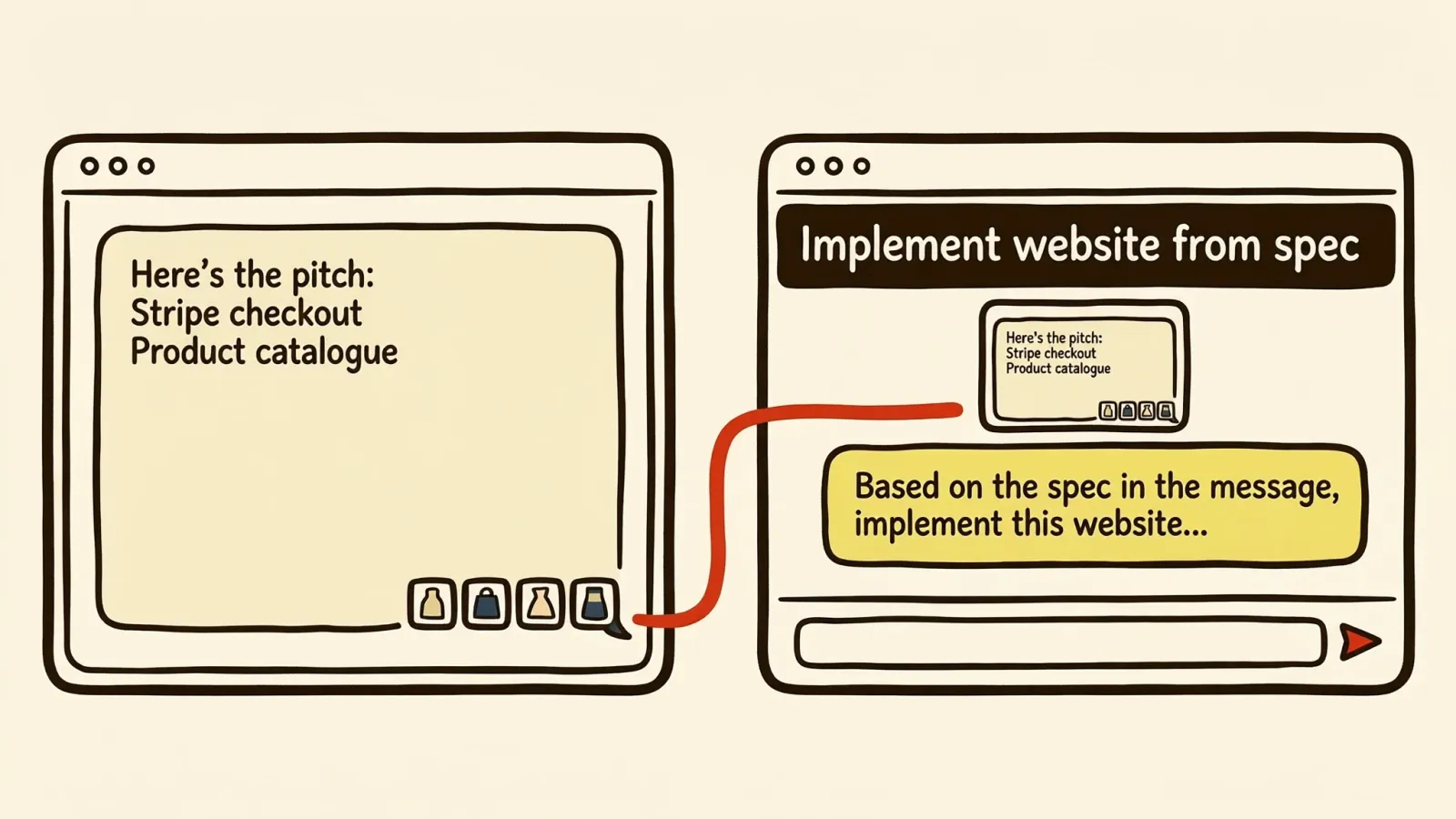
a colleague drops a casual Slack message — “here’s the pitch,” a few bullet points which is a screen grab, some example product photos attached — and thirty seconds later that same message gets pasted straight into Codex with “here’s a spec my colleague gave me, can you build this.” The Slack message just was the spec, and nobody involved had planned it that way.
That’s the moment that reminds me of a similar story — a voice transcript transitioning to a PRD for vibe code and vibe build. In 2026, that’s how specifications have evolved from documents and sign-off centric to “let’s get it off right now.”
“Specifications evolved from documents and sign-off to ‘let’s get it off right now.’”
I don’t use ChatGPT Work or Codex — I run Claude Code, and the tools in the recording look and behave differently from mine in almost every surface detail. But the shape and methodology underneath was identical to the loop I already run: plan out loud, hand off a spec, let an agent build against it, a QA agent runs the tests and edge cases, check the result, ship. I’ve written about this before as something I do on purpose — a designer agent, a builder agent, a tester agent, each one reading the same document instead of a shared memory of the conversation. Seeing the same pattern show up unprompted, in a completely different vendor’s product, run by people who’ve probably never thought about it as a “pattern” at all, is the kind of evidence that convinces me it isn’t a Claude quirk. It’s just how agile build-test-ship works now, regardless of which logo is on the tech.
The rest of the recording is worth watching for the same reason any good demo is — the logo generation, the ten t-shirt concepts generated by AI, the in-app browser scouting London shop locations, the Stripe checkout wired up from a .env file without anyone touching a payments dashboard. But none of that changed how I think about my own work. The Slack screenshot-to-spec moment did, because it’s proof the pattern doesn’t need to be engineered to show up. It just needs someone willing to hand off a clear description and get the momentum going.
I ended up doing what I always do when something teaches me a pattern I want to keep: I broke it into pieces I could reuse in my own moment of choosing. Claude CoWork and I went scene by scene through the recording and pulled out every prompt that was actually typed — the research request, the logo brief, the Slack message, the Codex handoff — so I’d have it as a reference the next time I’m planning something instead of building it. You can watch the walkthrough and read the full prompt breakdown here →